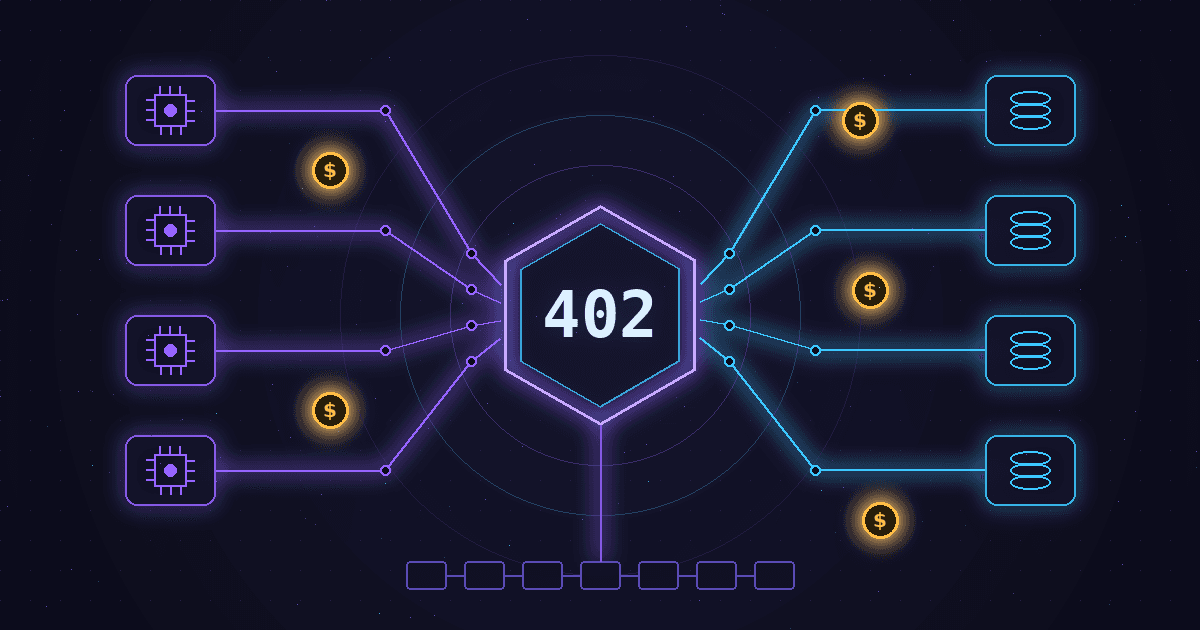
An engineer's view of x402: how HTTP 402, agent wallets and stablecoin settlement could reshape API business models, and the open questions ahead.
For thirty years, the web has had a status code nobody used. HTTP 402, "Payment Required", was set aside early on for some future way to pay for things online, and it stayed reserved because nobody agreed on how that would work. Cards, checkout pages and subscriptions filled the gap, and they were designed around a person holding a wallet and a password.
That assumption is starting to break. More and more API traffic comes from software acting for someone: coding agents, research agents, scheduled workflows that decide on their own which service to call next. x402 is a bet that these clients need a way to pay that is as native to HTTP as a GET request. I have been building on it, and this post is my view of where it could lead, and of the parts nobody has solved yet.
It is an opinion piece, not a tutorial. The protocol gets one section; the rest is about the ecosystem that might grow around it.
x402 in one section
x402 is an open standard, first developed at Coinbase and now stewarded by the x402 Foundation under the Linux Foundation, which announced its operational launch in July 2026. The idea fits in four steps:
- A client calls an endpoint.
- The server answers
402 Payment Requiredand describes what it accepts: amount, asset, network and recipient. - The client signs a payment and retries the same request with the payment attached in a header.
- The server checks the payment, usually through a facilitator that verifies and settles it on-chain, then returns the data with a settlement receipt.
There is no account to create, no API key to rotate and no invoice at the end of the month. The spec is network-agnostic (EVM chains and Solana today) and asset-agnostic, though in practice USDC is the default. Coinbase's documentation also describes pricing beyond a flat fee per request, such as authorising a maximum and settling what was actually used, or deferring settlement and batching it.
That is the whole mechanism. What makes it interesting is what happens when thousands of services and agents speak it.
Why agents don't fit the subscription model
Subscriptions and API keys assume a long relationship. A human signs up, compares plans, enters a card, copies a key into a config file and keeps paying whether they use the service or not. That works when a developer integrates three or four providers a year.
An agent working on a task behaves differently. It might need one call to a company registry, three to a pricing dataset and one to a translation model, all from providers it found ten seconds ago and may never use again. Asking it to open an account at each one makes no sense. Handing it your own card is a bad idea.
The usual workaround is an aggregator: one key, one bill, many upstream APIs. That helps, but it puts a middleman between every buyer and seller and recreates the gatekeeping that open protocols are supposed to remove. x402 takes the opposite approach. Payment travels with the request, so any agent with a funded wallet can deal with any provider that speaks the protocol, with no prior relationship.
The ecosystem I expect to form
Here is how I think the pieces could fit together over the next few years. Treat it as a forecast, not a roadmap.
Agent wallets become a standard piece of infrastructure. An agent gets a wallet with a budget, spending rules and an owner, much as a service account today gets permissions. The interesting product work moves to policy: per-task limits, allow-lists of providers, human approval above a threshold, and readable spending logs.
Data and APIs get sold by the call. A lot of valuable data is too niche for a subscription business: a specialised industry dataset, a regional registry, a narrow scoring model. Per-call pricing lets these exist as small products. A provider no longer needs a sales team or a billing system to earn from a handful of agents that need exactly that data.
Marketplaces and registries do the discovery. If agents choose providers at runtime, they need somewhere to look. I expect directories that list x402 endpoints with machine-readable descriptions, prices, uptime and compliance checks, closer to a package registry than an app store. Some already exist.
Services become buyers too. Once an API can be paid per call, it can also pay per call. A personalised analysis service can buy raw data from three providers, add its own model and resell the result. Value chains between machines get longer and finer-grained than any human procurement process would allow.
How stablecoin settlement changes API business models
The technical change is small. The business change is bigger than it looks.
- Prices can be tiny. Card fees put a floor under what you can charge for one transaction. Settling in a stablecoin on a low-fee network removes most of that floor, so a fraction of a cent per call becomes a viable price point.
- Cash arrives with the request. No net-30 invoices, no chargebacks months later, no failed renewals. For a small provider, that changes the risk profile entirely.
- Pricing becomes an API surface. The price is in the 402 response, so it can change per endpoint, per payload size or per time of day, and agents can compare offers automatically. That rewards providers who price honestly and punishes opaque ones.
- Anyone can sell, from anywhere. A solo engineer in Paris and a large data vendor expose the same interface. Distribution depends more on quality and discoverability, less on enterprise sales.
None of this removes the need for a good product. It removes much of the paperwork between a good product and its first paying machine.
The open questions
I am optimistic, but several problems are real, and pretending otherwise would be the hype I promised to avoid.
Identity. x402 tells you a payment is valid, not who stands behind it. For public data that is fine. For anything regulated, such as health, finance or personal data, providers will need to know more about the buyer, and the protocol does not yet have a standard answer for attaching a verifiable identity or attestation to a request.
Fraud and abuse. Agents can be manipulated. A malicious page can push an agent to pay for useless calls, and a fake endpoint can copy a real provider's description. Wallet policies, signed service metadata and reputation will matter as much as cryptography.
Pricing behaviour. We have little experience with markets where software negotiates prices with software in milliseconds. Price discovery, dynamic pricing and collusion between automated sellers are open topics, not solved ones.
Regulation. In Europe, MiCA now covers stablecoin issuers and crypto-asset service providers. Operating an API that receives USDC raises practical questions about accounting, VAT on cross-border digital services and who counts as the customer when the payer is an agent. Teams should involve an accountant early, not after the first payment.
Discovery and trust. Registries are useful only if their checks mean something. Listing criteria, uptime monitoring and compliance tests need to be transparent, or directories turn into spam lists.
Key custody. An agent wallet is a hot wallet. Who holds the keys, how they rotate and what happens when an agent is compromised are operational questions every team will have to answer.
A real-world example: AestheticData
My own test bed is AestheticData, a data API for AI agents in the medical-aesthetic industry. It currently offers two paid datasets, aesthetic brands and EU medical-device registrations, plus a free sample endpoint so an agent can inspect the data before paying. Agents pay per call in USDC through x402, with no subscription and no manual billing. The service is built in Python with FastAPI, using the official x402 SDK and Coinbase's CDP facilitator to verify and settle payments.
It is Listed on x402 List (approved October 2026), where it passed 14/14 x402 compliance checks and has had 100% uptime since monitoring began (as of October 2026).
The main lesson so far fits the theme of this post: the payment code was the easy part. Most of the effort went into what an agent needs before it decides to pay: clear endpoint descriptions, predictable responses and honest documentation.
What I would watch next
If you build APIs, I would watch three things: how agent wallet policies get standardised, whether registries converge on shared metadata and checks, and how identity gets layered on top of payment for regulated data. If those three mature, pay-per-call could become a normal way to sell software, not a crypto curiosity.
If you are deciding today, the cost of experimenting is low. Put one narrow, useful endpoint behind x402, describe it well, list it where agents look, and learn from what actually gets called.
FAQ
What is x402 in simple terms? An open standard that uses the HTTP 402 "Payment Required" status code so a client, often an AI agent, can pay for an API call inside the request itself, usually in a stablecoin such as USDC, without an account or API key.
Does x402 replace subscriptions and API keys? Not entirely. Subscriptions still suit steady, predictable usage by humans and teams. x402 suits occasional, automated or one-off calls, where signing up first costs more than the call is worth. Many providers will likely offer both.
Is x402 tied to one blockchain? No. The protocol is network-agnostic; current tooling supports EVM networks and Solana. USDC is the most common settlement asset, but the spec allows others.
References
- x402 Foundation, x402.org: https://www.x402.org/
- Linux Foundation announces operational launch of the x402 Foundation (July 14, 2026): https://x402.org/linux-foundation-announces-operational-launch-of-x402-foundation-to-standardize-internet-native-payments-for-ai-agents-and-applications/
- Coinbase Developer Documentation, "How x402 works": https://docs.cdp.coinbase.com/x402/core-concepts/how-it-works
- x402 docs, "Facilitator": https://docs.x402.org/core-concepts/facilitator
- coinbase/x402 on GitHub, x402 specification v2 and HTTP transport: https://github.com/coinbase/x402/blob/main/specs/x402-specification-v2.md
- IETF RFC 9110, HTTP Semantics, section 15.5.3 (402 Payment Required): https://www.rfc-editor.org/rfc/rfc9110#name-402-payment-required
- Regulation (EU) 2023/1114 on markets in crypto-assets (MiCA): https://eur-lex.europa.eu/eli/reg/2023/1114/oj
Thinking about selling data or an API to AI agents? Book a call on Calendly or write via hephaestus.fr/contact. Hephaestus (Zeliang Yao) designs and builds Python backends, agent tooling and x402 payment flows.
Comments
Leave a note with your name. No wallet connection is required.
Loading comments...