Real-time energy trading APIs with FastAPI on AWS EKS
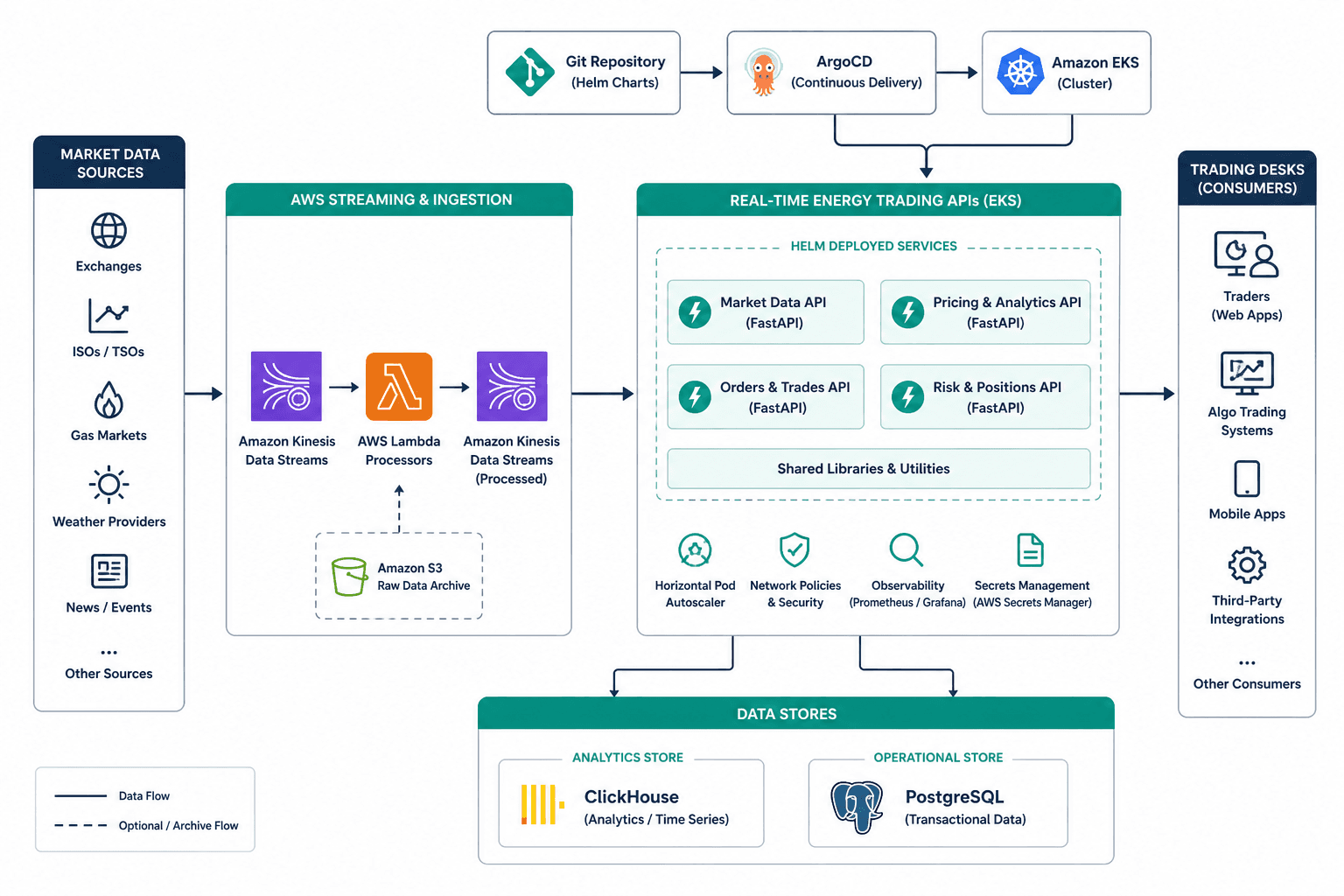
Design real-time energy trading APIs with FastAPI on AWS EKS: low-latency patterns, Kubernetes ops, and architecture for European power markets.
Energy trading systems live on latency, reliability, and clear contracts between services. Traders and automated strategies need fresh curves, positions, and order status; risk and ops need the same truths without fighting a tangle of ad hoc scripts. FastAPI on AWS EKS is a strong combination for this class of workload: Python’s speed of delivery, async I/O where it helps, and Kubernetes for scaling and rollout discipline on AWS.
This post outlines an architecture-level approach to real-time (or near-real-time) energy trading APIs—patterns useful for European power and gas contexts—without discussing confidential trading strategies or proprietary venue integrations in detail.
What “real-time” means in energy trading APIs
In practice, “real-time” is a spectrum:
- Sub-second reads of cached market snapshots or order acknowledgements
- Seconds for aggregated positions, P&L approximations, or curve updates after a tick batch
- Minutes for heavier risk recalculation or reconciliation jobs
APIs should advertise their freshness SLAs per endpoint. Pretending every route is “live” destroys trust when a curve is five minutes old. Design for honesty: last_updated, sequence numbers, and optional WebSocket or SSE channels for push updates.
Why FastAPI
FastAPI works well for trading-facing and internal APIs because:
- Native async support for concurrent I/O (market feeds, caches, databases)
- Automatic OpenAPI docs that become a living contract for frontends and partner systems
- Pydantic models that enforce request/response shapes at the boundary
- Straightforward dependency injection for auth, tenancy, and connection pools
For CPU-heavy pricing kernels, keep the hot path in optimized libraries or sidecars and let FastAPI orchestrate—do not block the event loop with long synchronous work.
Why AWS EKS
Amazon EKS gives you managed Kubernetes control planes with AWS-native networking, IAM, and load balancing. For energy trading APIs that must stay available across releases and traffic spikes around market opens or imbalance windows, Kubernetes offers:
- Rolling deployments and canaries with health checks
- Horizontal Pod Autoscaler (and optionally KEDA) on QPS or custom metrics
- Clear separation of namespaces for trading, risk, and shared platform services
- Integration with AWS ALB Ingress Controller, IAM Roles for Service Accounts (IRSA), and Secrets Manager / Parameter Store
You pay for operational maturity: cluster upgrades, node groups, and observability must be first-class—not afterthoughts.
Reference architecture (high level)
A typical layout:
- Edge — Application Load Balancer + Ingress; TLS termination; optional WAF; rate limiting for public or partner routes
- API pods — FastAPI (Uvicorn/Gunicorn workers as appropriate) behind ClusterIP or ALB target groups; readiness/liveness probes on
/healthand/ready - State — Redis/ElastiCache for hot market snapshots and session-ish data; Aurora PostgreSQL or similar for durable orders, trades, and audit
- Streaming ingress — Consumers (Kafka, MSK, or Kinesis) update caches and emit domain events; APIs read mostly from cache for low latency
- Workers — Separate Deployments for reconciliation, curve building, and batch risk—same cluster, different resource profiles and scaling rules
- Observability — Prometheus/CloudWatch metrics, distributed tracing, structured logs with correlation IDs per request and per trade lifecycle
The key architectural rule: write paths and heavy compute do not share the same pod resource pool as latency-sensitive read APIs unless you have proven they cannot starve each other.
Domain boundaries that keep systems sane
Energy trading platforms usually split concerns along lines such as:
- Market data — curves, indices, outages, capacity signals (as applicable)
- Orders & execution — lifecycle, status, fills (venue-specific adapters isolated)
- Positions & inventory — books, delivery periods, locations
- Risk & limits — pre-trade checks, exposure aggregates
- Reference data — products, calendars, counterparties
FastAPI services (or modules within a modular monolith early on) should respect these boundaries. Shared libraries for auth and logging are fine; shared mutable databases across every domain are how midnight incidents start.
Low-latency patterns that actually help
Architecture choices that improve perceived and measured latency:
- Cache-aside for read-mostly snapshots with explicit invalidation on events
- Connection pooling sized for pod concurrency; avoid reconnect storms on scale-out
- Read replicas for reporting-style queries that must not touch the primary
- Async endpoints only where I/O wait dominates; profile before rewriting everything
- Payload discipline—paginated lists, field selection, and binary protocols only when JSON becomes the bottleneck
For push updates, WebSockets or Server-Sent Events from dedicated pods can fan out curve ticks; sticky sessions or a pub/sub backbone (Redis, NATS) keep fan-out coherent across replicas.
Security and tenancy on EKS
Trading APIs handle commercially sensitive data. Baseline controls:
- mTLS or strict network policies between namespaces where justified
- IRSA so pods never hold long-lived AWS keys
- Short-lived tokens from your IdP; fine-grained scopes per desk or system account
- Audit logs for mutating endpoints (who changed what, when)
- Secrets outside the image; rotate routinely
Multi-tenant SaaS versus single-enterprise deployment changes isolation strength, but the principle is the same: least privilege end to end.
Deployments without drama
Energy markets do not pause for your release train. Prefer:
- Blue/green or canary on EKS with automated rollback on error-rate or latency SLO breach
- Database migrations that are backward compatible across at least one release
- Feature flags for new limit checks or venue adapters
- Load tests that simulate open/close bursts—not only average QPS
Document runbooks for “API degraded but trading continues” versus “hard stop”—operators need clear modes.
European context (architecture only)
European power markets introduce calendars, delivery periods, balancing concepts, and regulatory reporting expectations that affect data models and SLAs, not just UI labels. Architecture should make product calendars and location hierarchies explicit in reference data, keep timezone handling unambiguous (store UTC, display local), and isolate venue/protocol adapters so regulatory change in one market does not rewrite the core API.
Stay at that level of abstraction: no confidential matching engines, no proprietary curve recipes—just boundaries that survive audits and vendor change.
When FastAPI + EKS is the right call
Choose this stack when:
- Your team already ships Python services and needs strong OpenAPI contracts
- You need Kubernetes-level deployment control on AWS
- Multiple services (API, workers, stream consumers) must co-evolve
Consider alternatives (ECS/Fargate, Lambda + API Gateway) when the estate is smaller or traffic is highly event-driven and bursty with little long-lived connection state. WebSockets and sticky low-latency caches often push you toward always-on pods—hence EKS or ECS.
A practical delivery sequence
- Define OpenAPI for the first three critical resources (e.g. curve snapshot, position summary, order status)
- Stand up EKS with baseline observability and IRSA
- Ship FastAPI with cache + DB, health probes, and CI/CD canaries
- Add stream consumers to refresh caches
- Split workers and tighten network policies as load and team size grow
Ship the contract and the SLOs early; optimize kernels later.
Need a FastAPI-on-EKS trading or market-data API designed for production? Schedule 30 minutes on Calendly or contact hephaestus.fr/contact. Hephaestus SAS (Zeliang Yao, Paris) builds and hardens real-time Python APIs for demanding domains.
Comments
Leave a note with your name. No wallet connection is required.
Loading comments...