Building Clarity: a portfolio analytics platform on Python + AWS
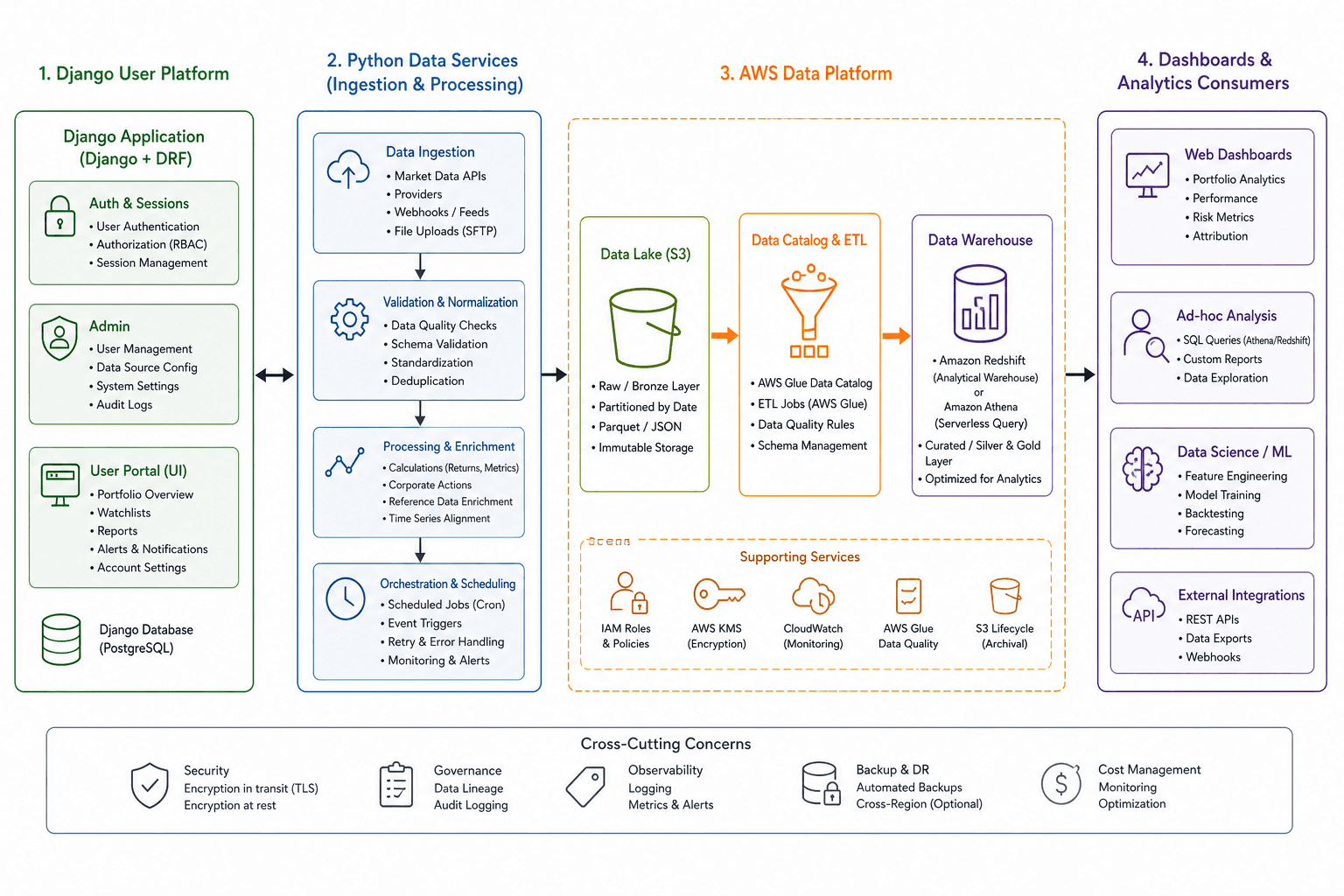
How Clarity delivers portfolio analytics with a Django user platform, Python services, and AWS data pipelines—architecture and design choices.
Portfolio managers and risk teams need more than spreadsheets. They need timely valuations, transparent attribution, and a system that scales when markets move and data volumes spike. Clarity is a portfolio analytics platform built to meet that bar: Django for the user platform and APIs, Python for modeling and orchestration, and AWS for elastic compute and durable storage, and an architecture that keeps calculation logic testable and observable.
This article walks through the architecture-level design of such a platform—the patterns that matter when you turn market and position data into actionable analytics—without diving into confidential client internals. If you are evaluating a build versus buy decision, or planning a greenfield analytics stack in Paris or remotely, the same building blocks apply.
Django as the user platform
Clarity’s human interface sits on Django + Django REST Framework. Portfolio managers, analysts, and ops staff authenticate into a Django-backed portal for watchlists, reports, alerts, and account settings. Django Admin covers user management, data-source configuration, and audit-friendly operational changes. DRF exposes the authenticated APIs that the portal and internal tools call, while heavier valuation and pipeline work stays in dedicated Python services on AWS.
Separating the user platform (Django) from the compute plane (Python workers + AWS storage/analytics) keeps permissions, sessions, and CRUD workflows boring and auditable—exactly what regulated portfolio teams expect—without forcing every calculation through the web request path.
What “portfolio analytics” actually requires
A serious analytics platform typically covers several concerns at once:
- Ingestion of positions, trades, benchmarks, and market data (prices, FX, curves) from heterogeneous sources
- Normalization into a consistent domain model (instruments, books, strategies, as-of dates)
- Computation of NAV, P&L, exposure, risk metrics, and performance attribution
- Serving results through APIs, dashboards, or exports with clear freshness guarantees
- Auditability—knowing which inputs and which code version produced a given number
Clarity-style systems treat these as separate layers so that a change in a pricing source does not force a rewrite of the UI, and a new attribution model does not break ingestion.
Why Python fits portfolio analytics
Python remains the default language for quantitative and data-heavy backends for good reasons:
- Rich ecosystem for numerical work (NumPy, pandas, and specialized libraries where needed)
- Strong fit for ETL and orchestration (Airflow, Prefect, or lightweight custom schedulers)
- Fast iteration on models that finance stakeholders can review in notebooks before promotion to production jobs
- Excellent AWS SDK and serverless support for event-driven pipelines
The trade-off is operational discipline: typed interfaces at service boundaries, CI that runs regression fixtures on known portfolios, and clear separation between research notebooks and production packages. Clarity-oriented platforms keep the “research” surface and the “serving” surface in the same language family without sharing mutable global state.
High-level AWS architecture
The reference architecture puts Django (auth, Admin, user portal + DRF) on the left as the user platform, with Python data services and AWS lake/warehouse layers feeding dashboards and analytics consumers.
A typical Clarity deployment on AWS separates batch analytics, serving, and shared data:
- Landing zone — Raw files or messages land in Amazon S3 (or arrive via API Gateway / EventBridge). Object versioning and lifecycle policies protect history without exploding cost.
- Processing — Python workers on AWS Fargate, ECS, or Lambda (for smaller transforms) read landing data, validate schemas, and write curated datasets. For heavier attribution or multi-book runs, containerized jobs scale horizontally.
- Curated store — Parquet or similar columnar formats in S3, optionally queried via Athena, or loaded into a warehouse (Redshift, Snowflake on AWS, or Postgres on RDS/Aurora for operational slices).
- API & apps — FastAPI or similar services behind an Application Load Balancer, with caching for hot dashboards. Authentication is handled at the edge (Cognito, IAM, or enterprise IdP).
- Observability — CloudWatch metrics and logs, structured correlation IDs per as-of run, and alarms on failed jobs or stale data.
This layout keeps compute ephemeral and data durable—the right default when overnight runs and intraday refresh both matter.
Data model and as-of semantics
Portfolio analytics lives and dies by as-of correctness. Clarity-style designs make the as-of date (and often a calculation timestamp) a first-class key on every result set. That enables:
- Reproducible recomputation when a price feed corrects a close
- Side-by-side comparison of “official close” versus “latest available”
- Safe backfills without silently overwriting published numbers
Instrument master data (identifiers, asset class, currency) sits in a controlled reference layer. Positions and trades reference those keys; analytics jobs never invent identifiers ad hoc in production paths.
Pipelines that stay maintainable
Rather than one monolithic “run everything” script, Clarity-like platforms use staged DAGs:
- Validate & stage — Schema checks, duplicate detection, FX completeness
- Enrich — Join market data, resolve corporate actions where applicable
- Compute — Valuation, attribution, risk slices
- Publish — Write results with run metadata; invalidate caches; notify consumers
Each stage is idempotent where possible: re-running the same as-of with the same inputs yields the same outputs. That property is what makes incident recovery boring—and boring is good in finance tech.
Testing and governance without theater
Architecture-level quality controls that pay off:
- Golden portfolios: small synthetic books with known expected P&L and exposures in CI
- Contract tests between ingestion schemas and compute jobs
- Feature flags for new attribution methods so production can fall back cleanly
- Access patterns that separate read-only analysts from pipeline operators
None of this requires leaking proprietary models; it is simply how you keep a Python + AWS system trustworthy as the team grows.
Performance and cost levers on AWS
Portfolio platforms often have spiky load: month-end, quarter-end, or after large corporate actions. Design for:
- Spot or Fargate Spot for non-latency-critical batch where interruption is acceptable
- Right-sized containers and memory profiling on pandas-heavy steps (spilling to disk or chunking large books)
- Partitioned S3 prefixes by as-of date and book to keep Athena/query costs predictable
- Caching of slow-changing reference data in ElastiCache or in-process with TTLs
Clarity’s value proposition is not “use every AWS service”; it is using a small set well so operators can reason about cost and latency.
Serving insights to humans and systems
Computation is only half the product. Delivery usually includes:
- REST or GraphQL APIs for portfolio summaries and drill-downs
- Export jobs (CSV/Parquet) for downstream risk or reporting tools
- Dashboards that respect entitlement by book or desk
APIs should expose freshness metadata (as_of, computed_at, source_versions) so clients do not treat stale caches as live truth.
Who this approach is for
Building a Clarity-class platform makes sense when off-the-shelf tools leave gaps in data model, attribution methodology, or integration with existing European market infrastructure—and when you need full ownership of the code path. It is less compelling if you only need a light dashboard on a single CSV dump once a month.
For investment firms, fintechs, and product teams that already live in Python, AWS is a natural substrate: familiar skills, strong compliance tooling, and regional deployment options that align with EU data residency preferences.
Getting started without boiling the ocean
A pragmatic path:
- Define the domain model and as-of rules first
- Stand up landing + one curated pipeline for a single book
- Add valuation and one attribution view with golden tests
- Expose a thin API and a minimal UI
- Harden observability and access control before adding desks
That sequence delivers visible value early while preserving room to scale.
Ready to scope a portfolio analytics build on Python and AWS? Book a 30-minute call on Calendly or reach out via hephaestus.fr/contact. Hephaestus (Zeliang Yao) helps Paris-based and remote teams design and ship production-grade analytics platforms.
Comments
Leave a note with your name. No wallet connection is required.
Loading comments...